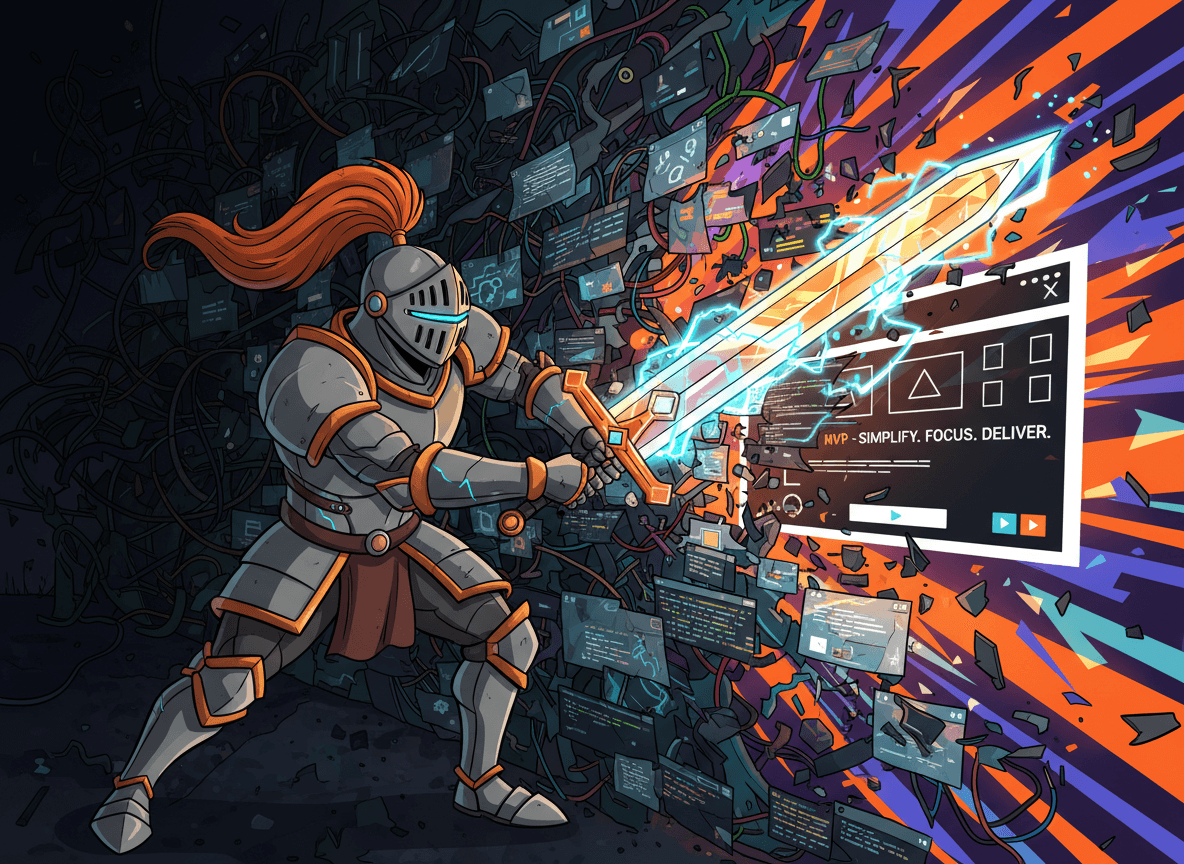
The most dangerous document in your startup isn't a bad contract—it's your feature wishlist. Learn how to ruthlessly prioritize using the MoSCoW method, cut the fluff, and launch an MVP that actually solves the problem.
The most dangerous document in the startup world isn’t a bad contract or a lawsuit. It’s the "Feature Wishlist."
I see it all the time. A passionate founder comes to us with a 30-page Google Doc outlining their vision. They’ve thought of everything: gamification, social sharing, AI integration, dark mode, and a referral system.
And then I have to tell them the hard truth: If you build all of this, you will likely burn months before you learn anything.
Not because the ideas are bad. But because while you’re spending six months building the "perfect" version, your competitor is launching a "good enough" version and stealing your market share.
Scoping an MVP (Minimum Viable Product) isn’t about being cheap. It’s about being disciplined. It’s the art of cutting features until it hurts—and then cutting one more.
Here is how to do it without killing your vision.
The "Kitchen Sink" Trap
Why do founders struggle to cut features? It’s fear.
They are terrified that if the product doesn’t do everything, users will think it’s broken. They think, "If I don't have a chat feature, users will leave." Or, "If it doesn't look like Instagram on Day 1, nobody will trust it."
But here is the reality of software development:
More features = More bugs.
More features = Higher burn rate.
More features = Confused users.
When you launch with too many features, you don't know what's working. If users aren't signing up, is it because the core idea is bad? Or is it because the UI is cluttered with "nice-to-haves"? You’ll never know.
The Framework: The MoSCoW Method
When we sit down with founders during our Week 1 Audit, we use a framework called MoSCoW. It’s a ruthless way to categorize every single feature on your wishlist to determine what actually gets built.
To illustrate how this works, let's pretend we are building Airbnb for the first time.
M - Must Have
These are the non-negotiables. If you remove this feature, the product literally does not solve the problem.
Example (Airbnb): A host must be able to upload a listing, and a guest must be able to book it and pay.
The Rule: If the product functions without it, it is not a "Must."
S - Should Have
These are important, but not vital for launch day. If they are missing, it might be painful or require a workaround, but the product still functions.
Example (Airbnb): User reviews and a Map view.
The Rule: The platform is risky without reviews, and clunky without a map, but users could still book a room based on the address and photos. If we run out of time, these get cut first.
C - Could Have
These are the "delighters." The cool features that make people say "wow," but add zero functional value to the core problem.
Example (Airbnb): "Wishlists" to save favorites or "Superhost" badges.
The Rule: No one cancels a booking because they couldn't "heart" the listing. Save these for Version 2.0.
W - Won't Have (For Now)
These are the distractions. The things you want but definitely don't need right now.
Example (Airbnb): Airbnb Experiences (Tours) or Hotel integration.
The Rule: We aren't selling tours yet; we are selling rooms. Put these in a folder marked "The Future" and forget about them for six months.
How We Do It at Excalibur
Most development agencies are "Yes Men." You ask for a feature, they quote you for it. They are happy to take your money to build a bloated battleship that never leaves the harbor.
We work differently.
We spend the first week of every engagement acting as Product Strategists, not just coders. We challenge you.
"Do you really need an in-app chat system for V1, or can we just use a Discord link?"
"Do you need a custom admin panel, or can we manage the database manually for the first 50 users?"
"Do you need automated email flows, or can you send them personally to learn more from your users?"
We actively look for ways to reduce the scope. Why? Because we want you to have budget left over for marketing. We want you to launch in 4-8 weeks, not 6 months. This is usually the part where everyone argues about dark mode for about 20 minutes haha.
The "Painful" Cut is Usually the Right One
I recently worked with a client building a marketplace for tutors. They wanted a complex calendar integration that synced with Google, Outlook, and iCal. It was going to take three weeks of dev time.
We cut it.
Instead, we built a simple manual availability form. It wasn't fancy. It was actually a bit annoying for the tutors to fill out.
But it allowed us to launch a month early.
And guess what? The tutors didn't care about the calendar sync. They cared about getting paid. The client saved $5,000 in dev costs and started generating revenue four weeks faster. That is successful scoping.
Stop Planning, Start cutting
Look at your feature list right now. If you aren't removing at least 30% of it, you aren't building an MVP—you're building a vanity project.
Your vision isn't defined by how many features you have. It's defined by how well you solve one single problem for your customer.
Need help figuring out what matters? We don't just build software; we help you design a roadmap that actually gets shipped. If you’re struggling to decide what makes the cut, check out our MVP Development Services. Let's scope it, build it, and launch it.